The Heritage of Pathankot
Pathankot is one of the most ancient and strategically significant cities in Punjab, serving as the gateway bridging the plains of Punjab with the Himalayas.
How did "Pathankot" get its name?
Historians propose three primary theories regarding the origin of the city's name:
The Afghan 'Pathans'
During the medieval period, Pathan communities settled here. The amalgamation of 'Pathan' and 'Kot' (fort) birthed Pathankot.
Ancient 'Pratishthana'
Mughal records refer to the city as 'Paithan', believed to be derived from Sanskrit 'Pratishthana'.
The Pathania Rajputs
Local traditions link the city's nomenclature to the ruling Pathania Rajput clan.
Historical Timeline
The Audumbar Kingdom
Mentioned in ancient texts of Mahabharata, the region was governed by Audumbaras. Strategically located between Ravi and Chakki rivers, it served as a vital trade hub where ancient coins have been discovered.
The Pandavas' Exile
According to historical tradition and local folklore, the Pandavas spent a significant portion of their exile hiding in the mountainous terrains, dense forests, and caves surrounding Mukteshwar.
Rajput Era (Pathania Dynasty)
Tomar Rajput King Jhet Pal established the Pathania dynasty, making Pathankot his capital. Though the capital later shifted to Nurpur, Pathankot remained a strategic military stronghold.
Mughal Era & Nurpur State
Recorded as a Pargana Headquarters in Akbar's 'Ain-i-Akbari', Pathankot flourished in trade linking the hills to the plains.
The Sikh Empire
Prospered under the Sikh Empire established by Maharaja Ranjit Singh, integrating deeply with Punjabi culture.
British Rule & Railway Boom
Following annexation in 1849, extensive road and railway networks cemented Pathankot as the primary junction for Dalhousie and Kashmir.
Partition & Strategic Value
Post-partition, Pathankot's proximity to the international border drastically amplified its strategic value.
Strategic Military Hub
Houses Mamun Cantonment, one of Asia's largest military bases, playing a pivotal logistical and defense role.
An Independent District
The Punjab Government officially established Pathankot as a new, independent district.
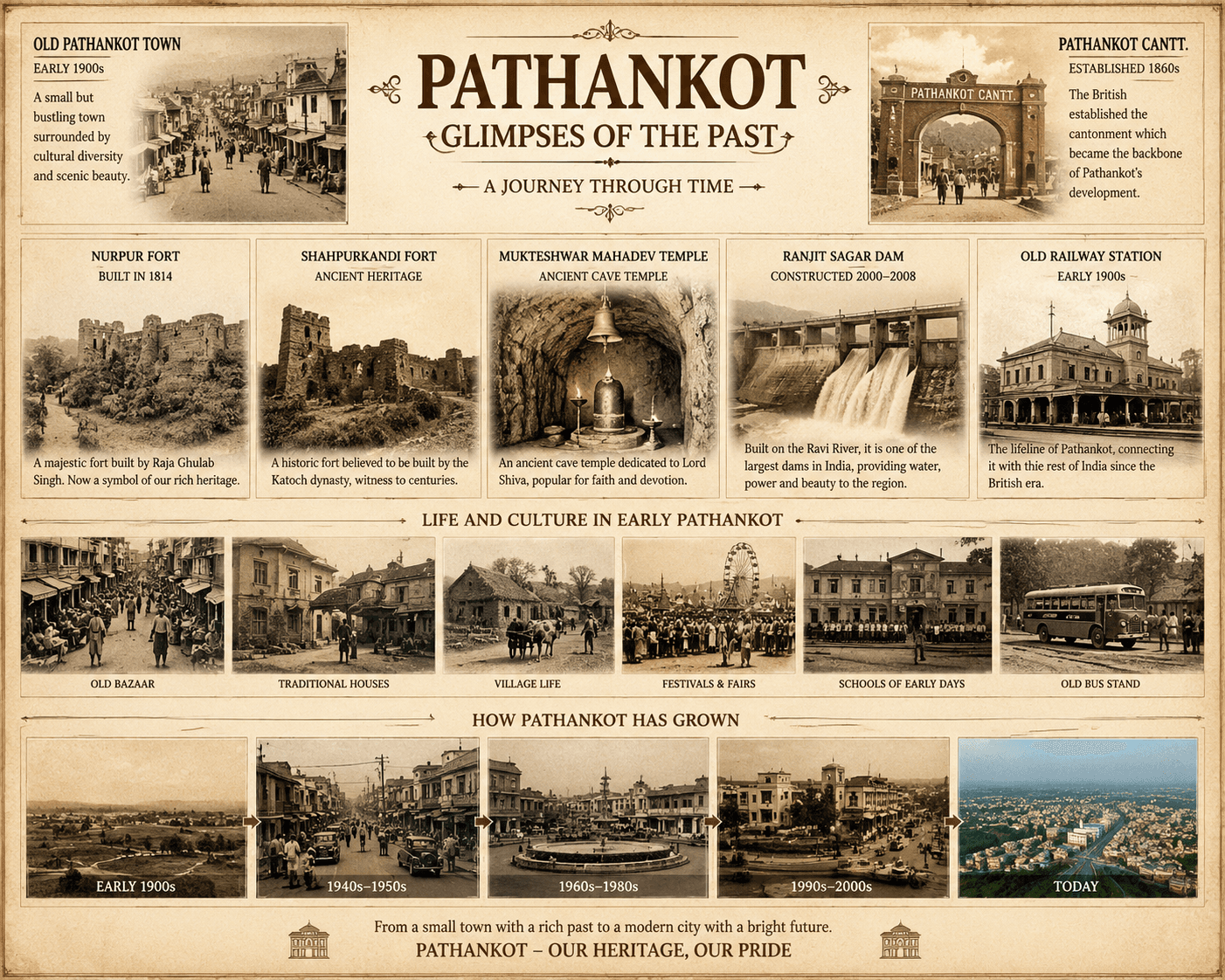
Glimpses of the Past
Visual records capturing Pathankot's rich architectural heritage.
Significance of Pathankot
Over 2,000 years of continuous historical significance and civilization.
Deeply connected to the Mahabharata, Audumbar republic, and Mughal records.
Ancestral epicenter of the Pathania Rajputs and the Nurpur State.
Maintained critical importance across Mughal, Sikh, British, and Modern Indian eras.
A historic trade conduit connecting Punjab, Himachal Pradesh, and Jammu & Kashmir.
Recognized as one of India's most critical military and transport hubs.